Anchor the story on intake to invoice.
A maintenance operator does not buy a module list. They buy fewer dropped handoffs between the first request, the field visit, the client update, and the final invoice.
The hard part of maintenance operations is not one task. It is keeping every party synchronized from the first request to the final invoice.
Role
Product framing, workflow model, go-to-market critique, and evidence planning.
Audience
Facilities maintenance owner-operators, teams with under 10 technicians, multi-office operators, vendors, field technicians, and clients who depend on accurate status and billing.
Maintenance ops
intake to invoice
Intake
Phone, email, portal
Dispatch
Skill, route, urgency
Field
Mobile updates
Billing
PO and invoice match
Live work order
Every assignment, update, and billing event stays connected.
Primary artifact
Intake-to-invoice coordination platform
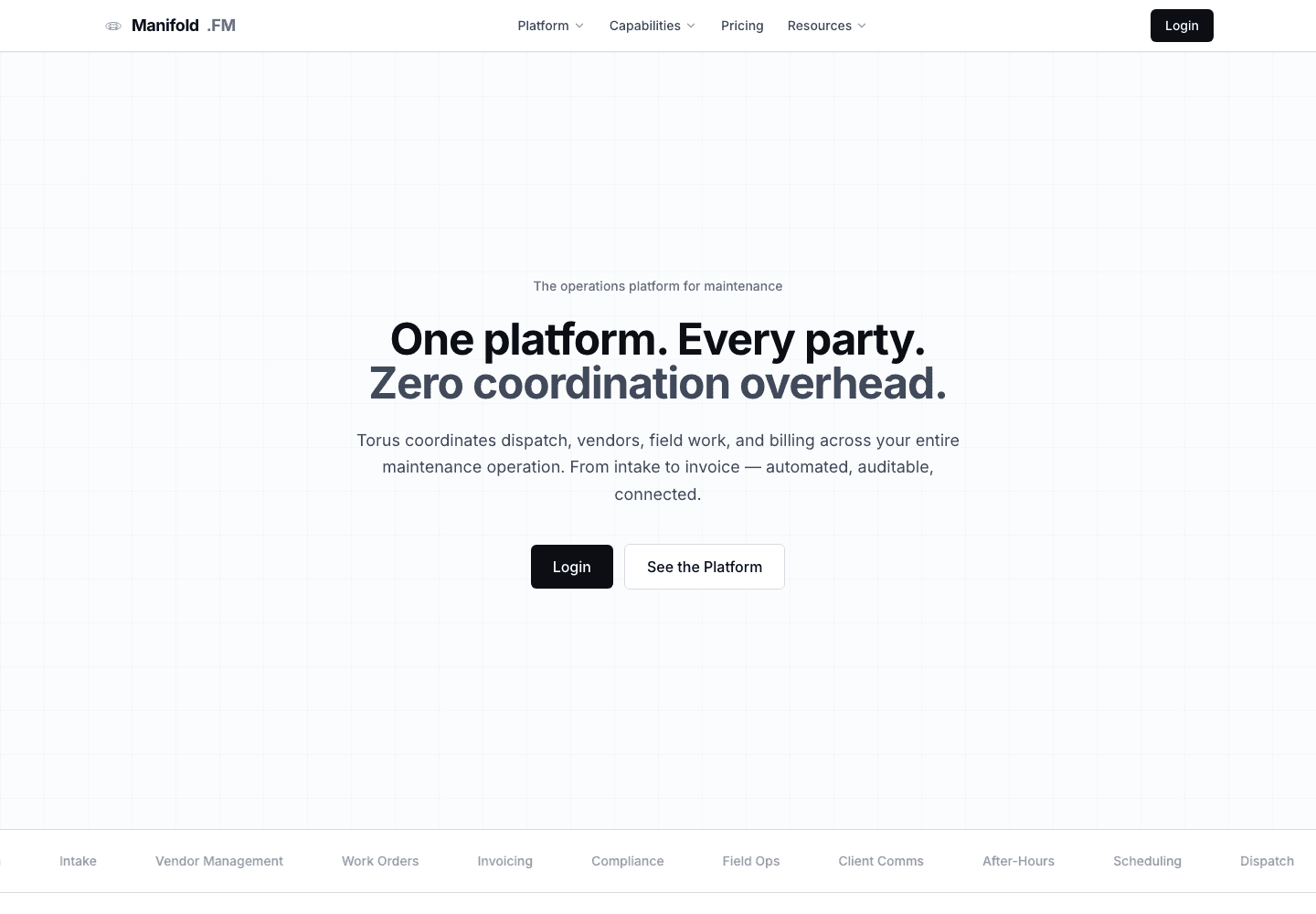
Live artifact: Manifold.FM positions Torus around coordinating every party in a maintenance operation from intake to invoice.
01 — Context
Torus is Manifold.FM's operations platform for facilities maintenance companies. The public product story centers on repetitive coordination work: request intake, dispatch, vendor management, field updates, client communication, after-hours triage, and invoice reconciliation. The product challenge is making automation feel operationally specific enough for owner-operators, small teams, and multi-office groups without forcing a rip-and-replace migration.
Product Question
Can Torus reduce coordination overhead across maintenance operations while connecting to the CMMS, dispatch, billing, and communication tools a business already uses?
02 — Problem
Maintenance work moves through calls, emails, portals, dispatch calendars, vendors, technicians, POs, invoices, and client updates. When those systems do not stay connected, the business pays in missed calls, manual follow-up, poor route density, slow emergency response, duplicate billing, overcharges, and support load.
03 — Evidence
Positioning
The public page leads with one platform for every party and frames the promise around reducing coordination overhead across dispatch, vendors, field work, and billing.
Workflow
Intake feeds dispatch, dispatch triggers field updates and follow-up, after-hours triage keeps urgent work moving, and invoicing closes the loop against POs and vendor communication.
Proof
The public case-study examples focus on measurable pressure: after-hours coverage, emergency revenue, admin load, vendor overcharges, and the ability to grow without adding back-office staff.
04 — Product Judgment
A maintenance operator does not buy a module list. They buy fewer dropped handoffs between the first request, the field visit, the client update, and the final invoice.
Starter, Growth, and Enterprise are not just pricing tiers. They map to different coordination loads: solo operators need admin leverage, small teams need dispatch and QA discipline, and multi-office groups need reporting, compliance, and integration depth.
Facilities teams already have tools. Torus is more credible when it connects CMMS, dispatch, billing, and communication systems instead of asking the customer to become a software migration project.
05 — Evidence Plan
Capture the configured product surfaces behind the marketing page: intake rules, dispatch board, technician mobile view, after-hours triage, invoice exception handling, and the audit trail that connects the workflow end to end.
Open Questions
Which integration creates the most trust fastest: CMMS, dispatch, billing, or communications?
Where should Torus stop automation and route work to human review?
What proof matters most by segment: response time, admin hours saved, emergency revenue, overcharges caught, or technician utilization?