Use the Plex mental model.
Plex explains the architecture quickly: hosted by you, reachable elsewhere. The analogy helps users understand the model before the implementation.
AI orchestration can be hosted by the user, reachable anywhere, and independent of a cloud workspace as the source of truth.
Role
Product strategy, positioning, system model, and interaction planning.
Audience
Builders and power users running multiple models, agents, projects, and conversations who do not want the operating layer trapped in someone else's cloud.
Local host
ReachableMachine
Daemon
Workspace source of truth
Desktop
Browser
Mobile
Cloud is reach, not ownership.
Primary artifact
Local orchestration system
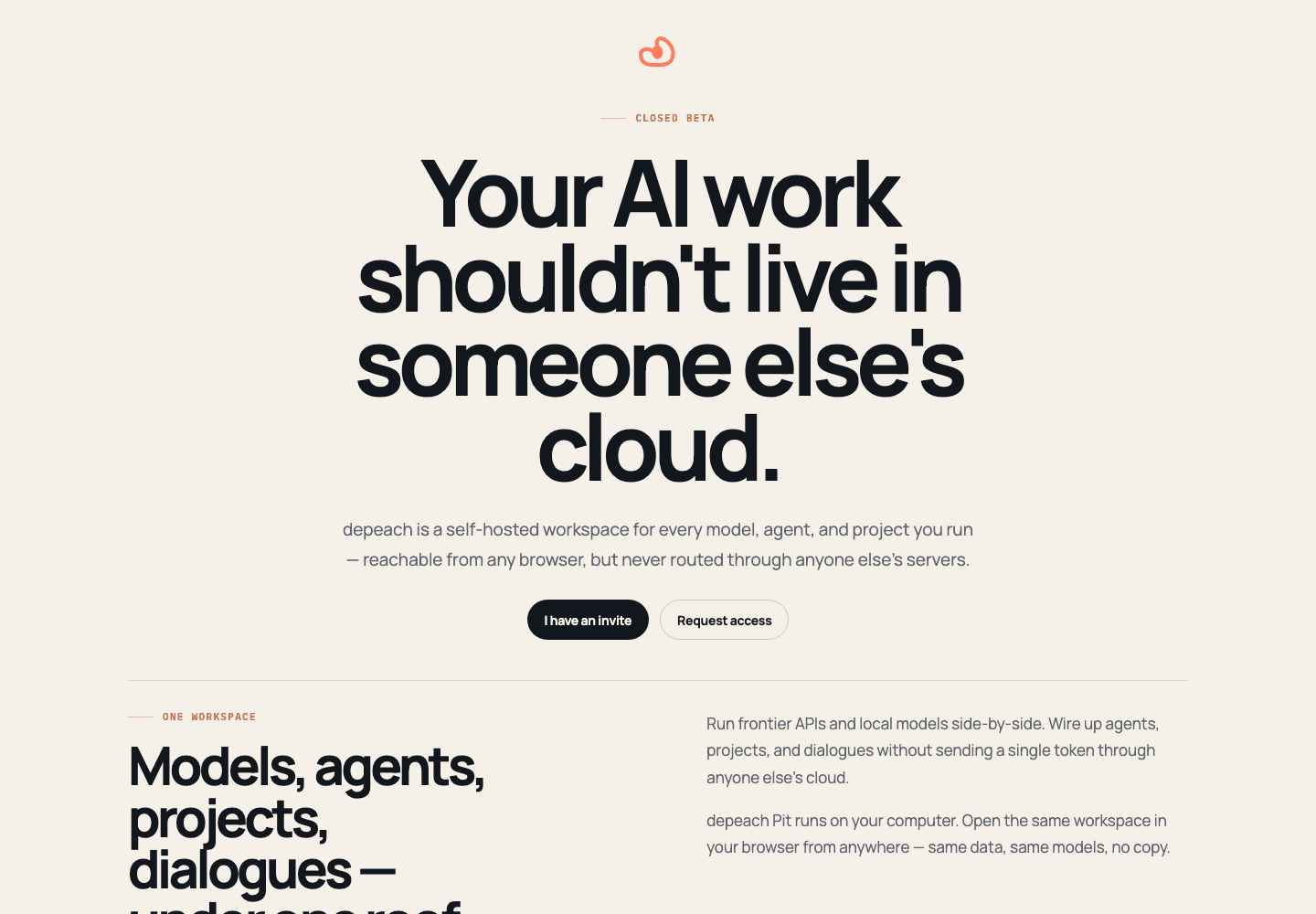
Live artifact: Depeach explains self-hosted AI work that can still be reached from a browser.
01 — Context
Depeach uses a Plex-like model for AI work: the local machine owns the workspace, and browser or mobile surfaces extend reach. The product challenge is making that ownership model understandable without making the experience feel technical.
Product Question
Can a self-hosted AI workspace be reachable anywhere without making the cloud the source of truth?
02 — Problem
AI work is increasingly spread across tools, providers, and machines. Cloud orchestration is convenient but raises control and ownership concerns. Purely local tooling preserves control but can become hard to access from other devices.
03 — Evidence
Positioning
The current site says AI work should not live in someone else's cloud. That gives the study a clear standard: every decision should reinforce user ownership and access.
Architecture
A useful diagram shows the local daemon, workspace source of truth, relay behavior, and access surfaces without overwhelming the page.
Experience
The model only works if browser and mobile access feel normal while the underlying ownership stays local-first.
04 — Product Judgment
Plex explains the architecture quickly: hosted by you, reachable elsewhere. The analogy helps users understand the model before the implementation.
The study needs to show that cloud services extend reach without becoming the system of record.
A local-first system still needs strong desktop, browser, and mobile surfaces. Architecture only matters if the interaction model makes it usable.
05 — Evidence Plan
Capture the actual desktop and browser surfaces, then pair them with a simple architecture diagram explaining local ownership and remote access.
Open Questions
What does the user see when their local host is offline?
How explicit should the relay model be in the product UI?
Which workflows matter most on mobile versus desktop?