Start with capacity, not history.
Transactions matter, but they do not answer the next decision. The interface leads with what is safe, what is committed, and what changes if the user spends now.
The useful question is not what is in the account. It is what can be spent without creating a future problem.
Role
Product framing, experience model, risk definition, and prototype critique.
Audience
People juggling recurring bills, discretionary spend, and credit-card payoff timing without a clear model of what is safe to spend.
Spending room
$1,240
Guardrail
Spending on credit changes next month's capacity.
Primary artifact
Spending capacity model
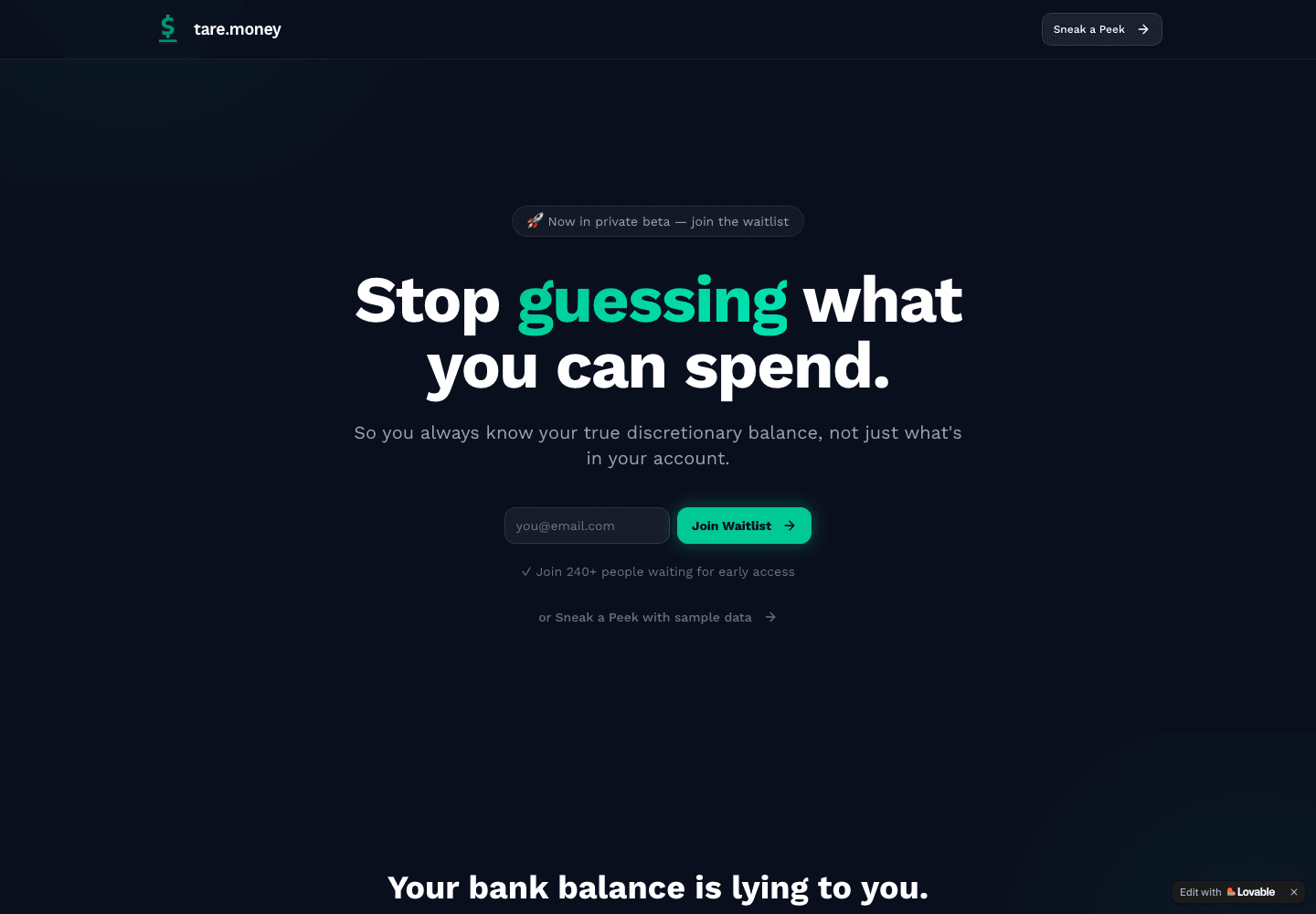
Live artifact: tare.money frames the product around true discretionary balance, not account balance alone.
01 — Context
Tare explores a common budgeting failure: people see a balance, forget what is already committed, and make a decision that looks affordable only in the moment. The prototype treats spending capacity as the primary object: committed bills, discretionary room, and credit exposure in one view.
Product Question
Can the experience make safe spending capacity clear enough to change behavior before the user overcommits?
02 — Problem
Most personal finance tools explain the past. They show transactions, categories, or balances. The harder user need is forward-looking: what happens if I spend now, pay this bill on credit, or carry part of the balance into next month?
03 — Evidence
Public promise
The landing page tells users to stop guessing what they can spend. The prototype can be judged against that standard.
Model
A useful artifact separates committed bills, discretionary room, and credit exposure while still making them feel like one decision.
Risk
Bill-payment leverage has to show repayment timing and the consequence of carrying debt. The strongest state is one where the product warns the user instead of encouraging spend.
04 — Product Judgment
Transactions matter, but they do not answer the next decision. The interface leads with what is safe, what is committed, and what changes if the user spends now.
Credit-card bill payment can help timing, but only when framed as a tradeoff with exposure and repayment assumptions.
Trust comes from constraint. Warnings, thresholds, and plain-language consequences are part of the experience, not compliance decoration.
05 — Evidence Plan
Capture the prototype with sample data loaded: capacity view, bill calendar, a credit scenario, and one state where the product warns the user instead of encouraging spend.
Open Questions
What inputs does the user need to provide before the capacity model becomes useful?
Where does the product explain uncertainty in the projection?
What is the responsible default when credit-card leverage looks mathematically useful but behaviorally risky?